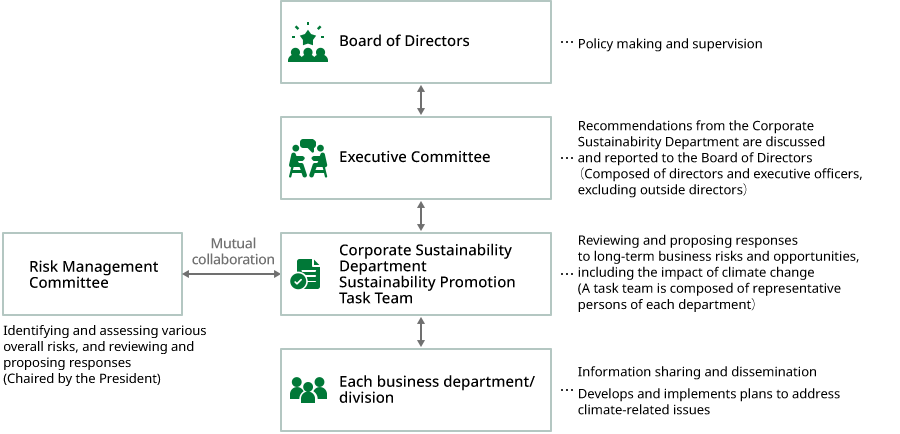
In the Lacto Japan Group, the basic policy and important matters related to environmental issues, including climate-related issues, are discussed by the Executive Committee and decided and supervised by the Board of Directors.
The Group has newly established the Sustainability Promotion Department to grasp changes in the business environment due to climate change, identify medium- and long-term climate-related risks and opportunities, and study Group-wide responses. While sharing information with each division and department, the Sustainability Promotion Department submits climate-related issues it has examined and proposals such as measures to be taken to the Executive Committee in conjunction with the Group-wide Sustainability Promotion Task Team.
In addition, the Sustainability Promotion Department sets targets and manages progress in addressing climate-related issues, and considers additional measures as needed in conjunction with the Sustainability Promotion Task Team. These measures are deliberated by the Executive Committee and reported to and supervised by the Board of Directors.
Considering the possibility that climate-related issues may also materialize in the medium to long term, the Lacto Japan Group identifies climate-related risks and opportunities that could have a significant impact on the organization's finances in the short, medium, and long term. Moreover, we discuss the potential impact of these identified risks and opportunities on the business and financial plans and utilize them in the consideration and formulation of the Group's strategy.
Climate-related risks and opportunities are identified based on medium-term (2030) and long-term (2050) world scenarios, assuming a 1.5°C scenario consistent with the Paris Agreement target and a 4°C scenario in which no measures to reduce global warming are taken beyond the status quo. In our scenario analysis, we refer to the following scenarios published by external organizations.
The Group has bases and is operating businesses in ten countries worldwide, as well as Japan. Furthermore, the products handled by the Group and their ingredients are produced in a wide range of countries and regions, including Europe, Oceania, the United States, and Asia, and we conduct scenario analysis that takes regional characteristics into account.
|
World view |
Transition scenarios |
Physical scenarios |
|
1.5℃ |
|
|
|
4℃ |
|
|
The Lacto Japan Group analyzes the entire value chain using multiple climate-related scenarios to comprehensively identify climate-related risks and opportunities. In addition, we identify risks and opportunities that are expected to have a particularly significant financial impact, taking into account the magnitude of the impact on our group's finances if they materialize and the duration over which the financial impact is expected to last.
Climate-related scenarios and the resulting risks and opportunities for the Group are regularly reviewed.
|
Type of risk |
Assumed risks and financial impacts |
|
|
Transition risk |
Policies and regulations |
|
|
Transition risk |
Market |
|
|
Transition risk |
Market |
|
|
Transition risk |
Market |
|
|
Transition risk |
Reputation |
|
|
Transition risk |
Reputation |
|
|
Physical risk |
Chronic |
|
|
Physical risk |
Chronic |
|
|
Type of opportunity |
Assumed opportunities and financial impacts |
|
Energy sources |
|
|
Products and services |
|
|
Products and services |
|
|
Products and services |
|
|
Reputation |
|
|
Reputation |
|
The Lacto Japan Group has developed measures and is pursuing activities to address the significant climate-related risks and opportunities that have been identified.
|
Measures to address risks and opportunities |
|
|
|
|
|
In the Lacto Japan Group, the Sustainability Promotion Task Team, a Group-wide organization managed by the Sustainability Promotion Department, identifies and assesses sustainability-related risks based on scenario analysis. Identified related risks are reported to the Risk Management Committee, chaired by the Representative Director, President and Executive Officer, and integrated into Group-wide risk management.
The Sustainability Promotion Department compiles sustainability-related opportunities and reports them to the Executive Committee. Sustainability-related opportunities reported at the Executive Committee are shared with each business division, and the relevant departments verify the business feasibility and take appropriate action.
Measures to address sustainability-related risks and opportunities are considered by the relevant business divisions, and plans are formulated and implemented. The formulated measures and plans are reported by the Sustainability Promotion Department to the Executive Committee for approval. Progress on the plans is reported to the Risk Management Committee and the Executive Committee, and then to the Board of Directors.
(Aim to achieve carbon neutrality by 2050)
-
 ESG Data Environment
(118KB)
ESG Data Environment
(118KB)
